Sunday, December 16, 2012

Dreams, shattered

     What happens when a dream, seemingly so close to happening, gets shattered? In A Raisin in the Sun, by Lorraine Hansberry, Walter gets his dream of being rich destroyed when he has his money taken by a "friend". Although he almost used the money to start up a liquor store, the bottom line is that all of it was taken; in the end, a dream is only a dream, and it can never become reality.
     Walter's life seems to revolve around money, which means that his life revolves around Mama's incoming check. Although it isn't his, he pleads to have some of the money to fulfill his dream of becoming rich. Slowly, Mama gives in and gives Walter a huge sum of money. When the family discovers that Walter's money was all stolen, everyone is downtrodden. However, the destruction of one dream gave birth to a new, better character in Walter. A dream cannot always be made into reality, but the journey to the dream is always worth it.
     Walter's eventual growth reminds me of things in my life that I haven't always been able to achieve. Maybe I wasn't able to get an A in a class or get 1st chair in the prestigious Troy Colts Marching Band, but the experiences of trying to reach success have always built upon my character. It has made me realize that being a hardworking person is more important than having a certain grade or chair, just as Walter realizes that his pride of his family is more important than his dream of being a rich man.

Sunday, December 9, 2012

A Black Man Talks of Reaping

     During the 1920s, African-Americans celebrated their culture in the Harlem Renaissance. Literature, music, and art flourished during this time. In A Black Man Talks of Reaping, Arna writes of the struggles that African-Americans faced at the time, and also shows the continual hardships that all of them will face in the future.
     The images and symbolism in A Black Man Talks of Reaping characterize the cycle of poverty and journey of African-Americans of the time. The "rows from Canada to Mexico" are clearly portraying how African-Americans are all trying to do something about their injustice, but to no avail. No matter how many seeds they plant across the country, only a few will be harvested. No matter how deep the seeds are planted, the "wind or fowl would take the grain away". This symbolizes the struggle that African-Americans have to face; it seems like everything in society is against them.
     Today, there is still injustice in America, but definitely less than before. Throughout history, many groups of people have been freed from societal oppression, like African-Americans, women, and Native Americans. Even though these groups may still experience prejudice, the strides that America has taken ensures that everyone will have peace and freedom in the end.

Sunday, December 2, 2012

The Great Gatsby

     Differing opinions about issues are all over the place. If everyone were to believe the same idea, and have the same philosophies, the world would be a very boring place. The Great Gatsby is a great example of an interesting book, made even more interesting by its various interpretations. Some critics say there is a prevalent "queer" theme in the novel, with others thinking that Fitzgerald is a sexist and/or racist.
     Although it may seem like a far stretch, some argue that Nick and others were "queer". They say that Nick was gay, and through Nick, others like Jordan and Gatsby appeared to be gay as well. Critics also picked up on Fitzgerald referring to African-Americans in a negative manner, which might point him to be racist, and he might be sexist because of the dominance of men over women in the novel. When these interpretations are analyzed together, they all seem like there are few, or no similarities between them. In fact, these interpretations are not similar at all; however, they do show that humans will always have their own, unique thought of things. 
     Just as The Great Gatsby has some radical interpretations, as some might think, history has many "interpretations" that people have widely argued. There are many conspiracy theories that a substantial amount of people believe in, such as NASA not really landing on the moon, the New World Order, or the deaths of people like Elvis and JFK. Some of these ideas might sound absurd, but there is some evidence to back up each case. Not only do people have different experiences and teachings, but they also have complex natures that causes them to have unique insights.
  

Sunday, November 25, 2012

Truth and Lies and... Human Nature

     People often say that lies should never be told. Others say that lies are fine, as long as they are used to help someone or something. This conflicting of ideas causes a problem that one cannot simply solve. Because some believe in the power of absolute truth at all times, and others think truth isn't always necessary, a flaw is born from the complex laws of society.
     How can a set of rules exist when two very different philosophies of truth exist? Well, the answer lies within the current condition of our country. This set of rules exists, but there are obviously many problems with it. The fact of the matter is that no perfect society can and ever will exist, because people will always have unique perspectives on everything, not just regarding truth or lies.
     In "The History Teacher", by Billy Collins, the history teacher tries to protect the kids by feeding harmless lies to the students. After, the students are described as bullies that treat others poorly. This is one case where telling lies still doesn't help anything, but then again, telling the truth may not have helped either. Telling the children that an atomic bomb was dropped on Japan probably wouldn't have made the kids any less violent than before.
     The endless loop of history repeating itself and the perpetual flawed state of society all goes back to the most basic element: human nature. Humans cannot be fully controlled, and thus, will eventually wreak some type of chaos.

Sunday, November 18, 2012

Another Post about Success!!!

     The dictionary definition of success is any "favorable or desirable outcome". If this is the case, then why does society need to determine who is successful? Only an individual can see if his/her own outcome was favorable or not. A favorable outcome to someone might be getting a lot of "likes" on Facebook, finding out hacks for Pokemon, or finally being able to march in step with everyone else in the prestigious Troy Colts Marching Band. However, society often falsely judges someone's success based on wealth, property, etc.
     Across the world, money is the major factor of determining who is successful. Different forms of wealth have been seen, like the cacao bean in Aztec and Mayan cultures, or the shekel in Mesopotamia, but in the end, these are still a form of currency. Success is viewed differently by Emily Dickinson, in her poem, "Success is Counted Sweetest". Dickinson expresses her view that an individual's success is greatest when he has never achieved it, and compares it to a great victory in war. This shows how only an individual can judge himself on his success, and not society.
     Society's definition of being successful is seen when a simple Google search is conducted. A "most successful person in the world" search on Google results in the lists of "The Most Influential People in the World" and "The World's Billionaires". Oh, and it also has a Wikipedia for Warren Buffet. Funnily enough, the most simple thing doesn't appear on this Google search: happiness. A person can find success in any form, not just money; it can be anything that one finds joy in.

Sunday, November 11, 2012

Secrets

     "Secrets can take many forms - they can be shocking, or silly, or soulful." Frank Warren discussed secrets and the impact they can have on people, whether leading to new ideas or a new direction in one's life. The power of secrets is seen in The Scarlet Letter, by Nathaniel Hawthorne, where Reverend Dimmesdale is eaten from the inside out by his one, darkest secret. Secrets are a double-edged sword: they can harm people, but also help people, depending on how they are used.
      Throughout The Scarlet Letter, Dimmesdale is continually breaking down and in the end, dies. When he makes his first appearance, Dimmesdale is a powerful speaker with a dominant air. He is the symbol of the Puritan community. After this, he slowly crumbles into a weak, broken figure. Although Dimmesdale is still a powerful speaker, his secret makes him so full of guilt that he has several episodes of being crazy. On the other hand, Hester has a secret that she made public. She was shunned by the community for a while, but she gradually became a respected member of the Puritans. The contrast between Hester and Dimmesdale throughout the novel is significant - Hester is ridiculed and Dimmesdale is saint-like, but in the end Hester is respected and Dimmesdale is ghost-like. Secrets can make a person blossom, as seen in Hester's case, but they can also make a person break, as seen in Dimmesdale's case.
     A hilarious example of someone "embracing" a secret is President Obama. He might have gotten angry and released his anger if he kept the opinion that he wasn't born in America inside of him. However, Obama just laughed about it openly in the video clip shown. As shown in examples from history and literature, people should be open about their secrets, or else it will cause them to mentally and physically break down.

Sunday, November 4, 2012

Who is "good"?

     In The Scarlet Letter, by Nathaniel Hawthorne, three characters are seen to be either suffering or trying to make someone else suffer. Hester is in the state of "ignominy" and is constantly looked down upon by the public because of her previous act, Dimmesdale is engaged in a conflict with himself because of his sin, and Chillingworth is trying to pry into Dimmesdale's life and cause him as much pain as possible. These people have definitely committed or are committing a wrong, but which one is the better person?
     Although Hester committed the terrible act of adultery in the past, she tries to live past that and be a giving, altruistic person. She knits for the whole community, including the poor, even though she is in a lower position than most in society. Dimmesdale has a part in Hester's sin, because he fathered an illegitimate child with Hester. Dimmesdale is engaged in a battle with himself because he doesn't know what to do: tell the Puritan community of his sin, or keep it inside of him. This dilemma is further complicated by constant admiration of the people to Dimmesdale, because they think he is some sort of God-sent wonder. Chillingworth is a leech that attempts to feed off Dimmesdale and gather all information regarding Dimmesdale, and he is successful.
     In the end, it is not about what society thinks, but what an individual does and thinks. Society thinks that Chillingworth is a great, learned man and a gift from God. Dimmesdale is also seen by society as a flawless man, a perfect example of a Puritan. However, society also views Hester as scum, as seen by how she lives in the outskirts of town by herself and her child. By living by herself, Hester shows herself as a resilient character, making her the better person. People shouldn't be judged by what they did in the past, but what are doing in the present. Hester continually does acts of kindness and also was open about her sin, while Dimmesdale hides it and Chillingworth tries to inflict pain on others.
     Someone who is not judged by what he did in the past is Chris Brown. Although many people know about his beating of his girlfriend, Rihanna, he is still successful today. Why? Society not only forgave him, but realized how he didn't do such things anymore. Everyone deserves a second chance, and as shown, benefits can arise from a simple second chance.

Sunday, October 28, 2012

"Self-Reliance" and more

     Transcendentalist themes, like celebrating the individual and nature, can be found across history, from the peak of the movement to present day. The thought of the inherent goodness of man and leading a simple life is the center of many essays, speeches, and movies. The popularity of this philosophy shows that people in all eras want to lead a simple life, but are barred by society and its constant expectations to actually live out a life of being nonconformists.
     A leader of the transcendentalist movement, Ralph Waldo Emerson wrote essays like "Self-Reliance" and "Nature" to emphasize the importance of the individual and nature. He says to "trust thyself" and that a real man "must be a nonconformist". Emerson's writing also has many aphorisms that hold true today, like "to be great is to be misunderstood". Historically, the ones that were misunderstood were also that ones that effected huge change in each person's time: Pythagoras revolutionized geometry, Socrates pioneered a new way of teaching and thinking, and people like Jesus, Luther, and Copernicus proved to have a profound impact even today. In "Nature", Emerson says that nature is like heaven. An individual finds his inspiration from nature; nature is perfect. The combination of a person's trust in himself and nature creates the perfect balance: a simple life of joy found in nature.
     In popular culture, one may think that transcendentalist really isn't in societal thought at all. However, a perfect example of someone who embodied the spirit of transcendentalism is Christopher McCandless, the subject in Into the Wild. Christopher McCandless was tired of the frenzy of society, and decided to find peace in nature. He just wanted a simple life, which is what he finally achieved. This is similar to what Emerson and Thoreau did, which was living by Walden Pond for a few years.
   

Sunday, October 21, 2012

Declaration of Independence and more

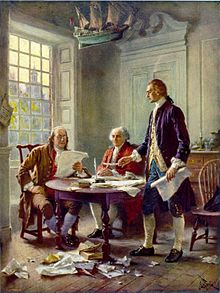
     The Declaration of Independence, written more than two centuries ago, is still one of the most famous documents in America today. It is often lauded as a masterpiece that captures the general philosophy of America itself, and many people agree with how everyone should have the same opportunities. However, the  Declaration has gaping contradictions, and the Declaration's ideas are not fully portrayed in today's society.
     Although the Declaration talks about everyone being "created equal", its writers contradicted themselves by owning slaves that obviously were not equal to their owners. Abolition of slaves may have been out of the question at the time, but the writers could have at least not owned slaves themselves. Also, the only ones given the unalienable rights of life, liberty, and the pursuit of happiness are white men. Native Americans, African-Americans, and women were all excluded.
     Not only are there huge contradictions in the Declaration, but it seems as if the Declaration's ideas were never fully followed at any point in time. After America won the Revolutionary War, it was still white males that had rights. African-Americans slowly gained power along with women after over a century of the Declaration's existence. In today's society, minorities face prejudice and don't have the same opportunities as most people; rights for the LGBT community is also a huge, controversial issue, showing that even after two centuries, the Declaration's values cannot be followed exactly.

Sunday, October 14, 2012

John Proctor's Death

     Sacrifice is a subject often explored in literature, movies, and popular culture. Most people would say that they would sacrifice some money or clothes to help the needy. But how many people would want to sacrifice more? An arm, an eye, a life? In order to do so, a person must truly believe in his or her moral values, and this is seen in John Proctor's death in The Crucible.
     In The Crucible, the Salem community is in hysteria over a few "sick" people, when in fact nothing is really the matter. However, Abigail's antics with her friends cause mass chaos, and Proctor's death is the result of this. John Proctor's death can be seen as a stepping stone toward a better community, because although his death didn't change anything in the short term, people gradually realized that accusing people of witchcraft was crazy. In the end, it is all about Proctor's morals: he disagreed with the accusation of people suspected of witchcraft, and paid the price because of it.
     Literature is full of sacrifices, and the Harry Potter series is a great example of this. Many people sacrifice themselves in order to improve the community and eventually cleanse it of the evils in their society. To name a few, Snape and Dumbledore died for Harry to kill Voldemort. Even in magical, fantasy novels the eternal theme of sacrifice of an individual for the greater good of the community is seen.
   

Sunday, October 7, 2012

Fear and Mobs

     When a huge mob forms, nothing becomes rational anymore. Irrational fears spring up from an idea of one person, and this fear spreads through the unthinking mass of people. This hysteria is seen throughout history and literature.
     In The Crucible, by Arthur Miller, witchcraft is thought to be the cause of Betty's ailment. Many people are accused and sent to jail without proof while the accusers stand, innocent. Although no proof is ever found of someone being a witch, the hysteria of the period and mob mentality allowed people to jail others without a second thought. The Crucible shows how one unsubstantiated idea can throw an entire community into chaos.
     Arthur Miller's inspiration for The Crucible was the Red Scare and the McCarthy hearings. During these times, people randomly accused each other of being communists. Just as how Rebecca, a pious individual of high social standing, is accused in The Crucible, famous Hollywood executives and actors were accused of being Communists without proof. The absurdity of the mass fear of Communism is seen when the Cincinnati Reds had to temporarily rename themselves the "Redlegs" to avoid any thought of their having ties with the Communist Party.
     While the Salem witch trials and the fear of communism certainly did cause a lot of confusion, society has learned from its mistakes. These historic events serve as a reminder to everyone to not judge prematurely; everyone is innocent before proven guilty.

Sunday, September 30, 2012

Heritage

    Heritage does in fact determine who we are as people. Although some people try to stop this from happening, societal pressures ultimately make people conform to what their heritage wants them to be. Trying to break away from heritage results in people looking down on whoever is straying from a stereotype.  Not only does heritage teach specific cultural values to a person, but it also teaches a person to dress, speak, and act a certain way.
    In class this week, we watched a series of clips that displayed early television writers' thoughts on Native Americans. Although we don't think Native Americans are savage, awkward brutes today, it was the thought during the 1920s and 1930s. Even in the film "Smoke Signals", it shows that heritage determines who we are. Thomas's upbringing results in his love in Native American things, like talking about the past stories of his culture. In trying to be the "real Indian", Victor conforms to the stereotype of Native Americans. Though both Victor and Thomas have very different personalities, their heritage determined who they would be: Native Americans at heart.
    I think my heritage also determined who I am as well. My parents always taught me to study hard, be honest, and not spend too much time fooling around. These little childhood tips molded me to who I am today. Heritage is passed on from generation to generation, and the same values pop up in a culture because of parents passing values down to their children. In this way, a culture grows and has unique traits of its own over time.
   

Sunday, September 23, 2012

Tricksters Everywhere!

     Tricksters are usually deities, animals, or people that break social rules by using trickery and deceit. These characters are clever and often try to avoid any harm that they themselves have caused. A trickster's creative ways to get him or her out of trouble usually leads something new that benefits someone. In order to obtain food, tricksters will weave an intricate lie or trick their way to it. However, not everything about a trickster is negative; tricksters create humor in otherwise humorless situations. In Native American culture, tricksters are coyotes and ravens.
     In the "Coyote and the Buffalo", retold by Mourning Dove, the trickster is the coyote. His own mistake, disrespecting the buffalo's skull, causes the coyote to run away and creatively find a way to live. Coyote's mistake unexpectedly causes the buffalo to kill Young Buffalo. Coyote's greed is seen when he kills the cow, but has all the food taken from him. Not only is a trickster greedy; he also has a huge pride issue that the old woman in "Coyote and the Buffalo" takes advantage of.
     Tricksters aren't only seen in Native American stories. They appear in modern society as archetypes and stock characters in television. One well-known trickster is Bart Simpson. He often causes trouble and does things that society frowns upon, like mooning people. Bart usually gets choked by his father for these acts, but then gets out of the punishment by tricking his way through.
     Tricksters across pop culture and literature cross societal boundaries and cause trouble to explore cultural order and flaws. They make readers question the ultimate authority and judge of such acts. Who is to say that one cannot break societal walls? Just society? Would these laws or views change gradually with time? Tricksters are necessary parts to any story, show, or movie.

Sunday, September 9, 2012

First Post!

Just created my blog! This looks kind of complicated, but I think I will get the hang of it after some time.